


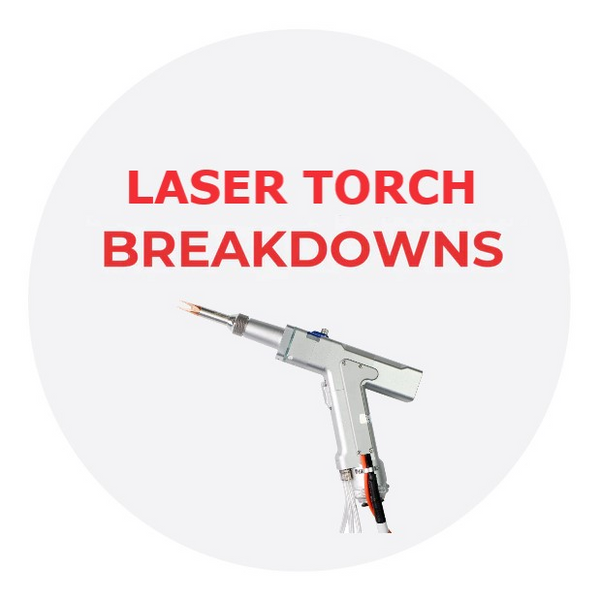
Flex Lase™ Handheld Laser Welding System

The Flex Lase™ Handheld Laser Welding System is a 2kW, air-cooled handheld laser welder from Lincoln Electric designed to weld stainless steel, carbon steel, and aluminum at travel speeds up to 4x faster than traditional TIG welding. It cuts operator training time to as little as 30–60 minutes, reduces distortion and spatter through a focused heat input, and supports both autogenous (laser-only) and wire-fed welding — including Lincoln's HyperFill® twin-wire process for larger welds. It's also available in a fully automated cobot configuration for high-mix production environments.
What Is the Flex Lase™ Handheld Laser Welding System?
Lincoln Electric introduced the Flex Lase™ system to bring the company's decades of laser welding expertise into a handheld, shop-floor-ready package. Instead of retrofitting an industrial laser cell, fabricators get a portable 2kW laser power source paired with a handheld gun that behaves more like a precision tool than a traditional welding torch.
The core idea is simple: replace the slow, skill-dependent parts of TIG welding — careful arc length control, filler dip technique, and torch manipulation — with a system where the operator mainly needs to keep the gun tip tracking the joint while a visible guide laser and preset parameter library handle the rest.
David Lansberry, Portfolio Manager of Industrial Equipment at Lincoln Electric, summarized the goal this way: the system delivers "the speed and precision operators need — without the steep learning curve."
Key Features and Benefits
1. Fast Travel Speeds
The headline benefit is speed. Flex Lase achieves travel speeds up to 4x faster than a typical TIG welding process, without sacrificing weld quality — a major factor for shops trying to increase throughput without adding headcount or equipment.
2. Easy Onboarding
Because much of the process variability is engineered out of the system, new operators can reportedly reach production-quality welds in as little as 30–60 minutes of training. The consistent focal point, visible guide laser, and factory-tuned preset library remove most of the trial-and-error learning curve associated with TIG and MIG welding.
3. High-Precision Welding
The focused heat input and smaller heat-affected zone (HAZ) help:
• Reduce material distortion
• Minimize spatter
• Improve overall weld process quality and repeatability
This makes Flex Lase especially well suited to thin-gauge and cosmetic-sensitive applications.
4. Versatile Process Support
Flex Lase supports both:
• Autogenous laser welding (no filler wire) for thin materials and tight-tolerance joints
• Wire-fed laser welding, including HyperFill® twin-wire technology, for larger welds and higher deposition rates
It's optimized for stainless steel, carbon steel, and aluminum, covering a broad range of industrial materials.
5. Industrial-Grade Durability
The system is built to withstand demanding shop-floor conditions, giving fabricators confidence in long-term reliability rather than treating the laser gun as delicate lab equipment.

Flex Lase™ Ready-Pak® — The Turnkey Package
For shops that want an out-of-the-box solution, Lincoln Electric offers the Flex Lase™ Handheld Laser Ready-Pak® (K5772-1), a complete, cart-mounted system that includes:
| Component | Description |
|---|---|
| Flex Lase 20 power source | 2 kW (2,000W), air-cooled laser power source; 2-year warranty |
| Flex Feed® 25L wire feeder | Based on the proven Power Feed® 25M platform; enables HyperFill twin-wire welding |
| Industrial cart | Includes gun holster, cable management, and on-board storage; 1-year warranty |
| Laser-rated helmet | One passive laser-rated welding helmet |
| Laser-rated safety glasses | Two pairs included |
| Customized user interface | Preset welding parameters developed by Lincoln Electric's Weld Development and Application Engineering teams |
This Ready-Pak configuration is designed so a shop can go from delivery to production welding with minimal additional setup.


Flex Lase Cobot: Automated Laser Welding
For manufacturers scaling beyond manual handheld welding, Lincoln Electric offers Flex Lase cobot systems, which merge the Flex Lase laser platform with collaborative robotics for high-mix manufacturing environments.
Key characteristics of the cobot configuration:
• The laser power source and cobot arm are controlled through a single teach pendant, rather than separate controls
• Mounted on a mobile cart so the system can be moved directly to the work area
• Features an integrated laser enclosure that provides Class 1–safe operation, reducing the facility-level safety infrastructure otherwise required
• Designed as a "programming-ready" platform suited to real-world, mixed-part production runs rather than single-part-number automation
This positions Flex Lase as a system that can scale from a single handheld unit to a semi-automated production cell using the same core laser technology.
Safety Requirements
Laser welding safety is not optional, and Lincoln Electric is explicit about this:
• The Flex Lase power source is a Class 4 laser instrument, which requires strict adherence to laser safety procedures.
• An activation code is required before the system can operate. This code is issued only after the customer registers the equipment and signs a Laser Safety Acknowledgement — a one-time requirement at first startup.
• Handheld Flex Lase systems should be operated within a Class 1 Laser Safe Enclosure that has been reviewed and approved by an on-site Laser Safety Officer (LSO).
• The cobot configuration's integrated enclosure is specifically engineered to deliver Class 1–safe operation, simplifying compliance.
• Laser-rated helmets and safety glasses (included in the Ready-Pak) are mandatory PPE for operators and anyone within the laser-controlled area.
Shops evaluating Flex Lase should plan for these facility and administrative safety requirements alongside the equipment purchase itself.

Ideal Applications
Flex Lase is best understood as a productivity upgrade for situations where TIG's heat input and travel speed limit output, rather than a drop-in replacement for every welding process. Common applications include:
• General fabrication — enclosures, cabinets, and structural brackets
• Electrical and HVAC panels — stainless and carbon steel housings where precision and finish quality matter
• Food service equipment — cosmetic, low-distortion welds on stainless steel
• Thin-gauge sheet metal — where minimizing heat-affected zone and warping is critical
• High-mix production — via the cobot configuration, where part variety makes fixed automation impractical

Frequently Asked Questions
What is the Flex Lase™ Handheld Laser Welding System? It's a 2kW, air-cooled handheld laser welding system from Lincoln Electric that welds stainless steel, carbon steel, and aluminum at speeds up to 4x faster than TIG, using a combination of a laser power source, a handheld gun, and factory-tuned welding presets.
How much faster is Flex Lase than TIG welding? Lincoln Electric states Flex Lase can achieve travel speeds up to four times faster than a typical TIG welding process, while maintaining weld quality.
How long does it take to train an operator on Flex Lase? According to Lincoln Electric's documentation, new operators can be executing production-quality welds in roughly 30 to 60 minutes of training, thanks to the visible guide laser and preset parameter library.
What materials can Flex Lase weld? The system is optimized for stainless steel, carbon steel, and aluminum.
Does Flex Lase require special safety equipment? Yes. It's a Class 4 laser instrument that requires a Class 1 Laser Safe Enclosure reviewed by a Laser Safety Officer, laser-rated helmets and glasses, and an activation code obtained after registering the equipment and signing a Laser Safety Acknowledgement.
Can Flex Lase use filler wire? Yes. It supports both autogenous (wireless) welding and wire-fed welding, including Lincoln Electric's HyperFill® twin-wire process for larger welds and higher deposition rates.
Is there an automated version of Flex Lase? Yes. Lincoln Electric offers Flex Lase cobot systems that pair the same laser welding technology with a collaborative robot arm, controlled through a single teach pendant, for high-mix automated production.
What comes in the Flex Lase Ready-Pak? The Ready-Pak (K5772-1) includes the Flex Lase 20 power source, a Flex Feed 25L wire feeder, an industrial cart with cable management and storage, a laser-rated welding helmet, and two pairs of laser-rated safety glasses.
What's the power output of the Flex Lase system? 2 kW (2,000 watts), delivered through an air-cooled laser power source.
Who is Flex Lase best suited for? Fabrication shops and manufacturers doing stainless, carbon steel, or aluminum welding — particularly enclosures, panels, brackets, and other applications where TIG's speed or heat input is a bottleneck, and where reducing new-operator ramp-up time is a priority.
Final Thoughts
The Flex Lase™ Handheld Laser Welding System reflects a broader shift in metal fabrication: laser welding technology once reserved for large industrial cells is becoming accessible as a handheld, shop-floor tool. By combining a 2kW laser power source, intuitive presets, and a clear path to automation through its cobot configuration, Lincoln Electric is positioning Flex Lase as both an immediate productivity upgrade and a long-term automation platform.
For shops weighing the switch, the key considerations are less about whether the technology works — the speed and precision gains are well documented — and more about facility readiness: laser safety enclosures, LSO sign-off, and operator training logistics.
Specifications, features, and packaging details reflect Lincoln Electric's published product information as of September 2026 and may be updated by the manufacturer over time. Always confirm current specs, pricing, and safety requirements directly with Lincoln Electric or an authorized dealer before purchasing.